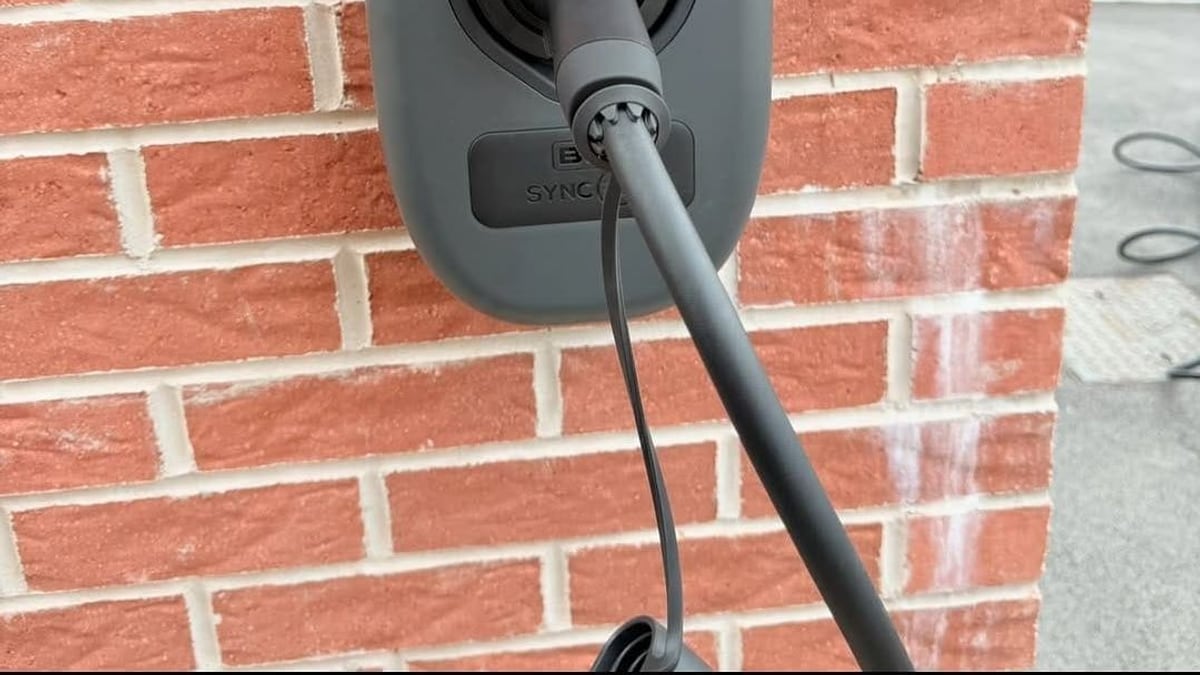
Charging an electric car at home costs roughly £140 a year on an overnight EV tariff, based on 8,000 miles in a typical car. On a standard electricity tariff it is nearer £500. Charge the same car entirely on public rapid chargers and you are looking at about £1,600 a year.
That is the whole story in three numbers, and the gap between them is bigger than most people expect. Below is where it comes from, and how to work out your own figure rather than an average.
The three numbers that decide it
Your annual cost comes down to three things, and only three:
- How efficient your car is, measured in miles per kWh. Most UK EVs manage between 3.4 and 4.0 in real conditions. Manufacturer range claims are optimistic; these are the numbers people actually get.
- What you pay per kWh. An overnight EV tariff is around 7p. Standard domestic electricity is around 25p. Public rapid charging is around 79p.
- How far you drive. The UK average is about 7,400 miles a year.
Multiply those together and you have your answer. Rather than make you do it, we built a calculator that takes your car, your tariff and your mileage and gives you the figure in a couple of seconds.
Home versus public, per mile
Per-mile is the fairest comparison, because it strips out how much you drive:
| How you charge | Price per kWh | Cost per mile |
|---|---|---|
| Home, overnight EV tariff | about 7p | about 1.8p |
| Home, standard tariff | about 25p | about 6.5p |
| Public rapid charger | about 79p | about 20p |
| Petrol car at 45mpg | n/a | about 13p |
Your own number is above. The calculator at the top of this page takes your car brand, your tariff and your mileage and gives you the figure in a couple of seconds. No email needed.
Two things stand out.
Charging at home on an overnight tariff is about seven times cheaper than petrol. That is the number that makes an EV make sense financially.
Public rapid charging can cost more per mile than petrol. At roughly 20p a mile against 13p for a 45mpg petrol car, someone who relies entirely on rapid chargers is paying more to run an electric car than they would a petrol one. This is the part nobody mentions in the showroom, and it is exactly why home charging matters so much.
There is a second cost, and it is your battery
Money is not the only thing rapid charging costs you. Charging power is now the single biggest behavioural influence on how quickly an EV battery ages.
Geotab’s January 2026 study, which tracked 22,700 electric vehicles, found:
| Mainly charged by | Battery degradation per year |
|---|---|
| Home AC or lower-power charging | about 1.5% |
| DC rapid charging above 100kW | about 3.0% |
Roughly double. Idaho National Laboratory saw the same pattern in controlled testing: 27% capacity lost after 52,800 miles on rapid charging alone, against 23% on AC.
Be clear about what this does and does not mean. Occasional rapid charging on a long trip is fine. The research puts that at around 0.1% extra degradation a year, which is nothing, and a separate study of 12,500 Teslas found no meaningful difference at all between heavy and light rapid users. Modern liquid-cooled packs handle it far better than the early cars did.
The problem is only when rapid charging becomes your main method, because you have nowhere to charge at home. Then you are paying twice: about ten times more per mile, and roughly double the annual battery wear. Heat makes it worse, which is why rapid charging on a hot day is the hardest thing you can do to a pack.
This is also what the manufacturers themselves recommend. Tesla, Kia and Hyundai all advise AC charging for everyday use and rapid charging for travel. A home charger is simply how you follow that advice.
Why is public charging so much dearer?
You are not just buying electricity. The price covers the charger hardware, a substantial grid connection, card payment fees, maintenance, vandalism, site rent and the operator’s margin. Rapid units in particular are expensive pieces of kit that need serious power delivered to them.
Public charging is a convenience product, priced accordingly. It is genuinely useful on a long trip. It is a poor way to do your everyday charging.
Do you need a special tariff?
To get near 7p, yes. Tariffs like Octopus Go and Intelligent Octopus give you a cheap window overnight, typically somewhere between 11pm and 6am.
There is a catch, and it is the reason this matters to an electrician. A three-pin plug charges too slowly to use that window properly. A granny lead draws about 2.3kW, so in a seven-hour cheap window you would add roughly 16kWh, around 60 miles. A 7kW wall charger adds nearer 49kWh in the same window, comfortably a full charge for most cars.
So the cheap tariff and the proper charger go together. One without the other does not get you the low running cost.
What it does to your electricity bill
Charging 8,000 miles a year uses roughly 2,100 kWh. The average UK household uses about 2,700 kWh a year in total, so home charging can nearly double the units you consume.
That sounds alarming until you look at what you pay for them. On an EV tariff those units cost around 7p rather than 25p, so the bill increase is far smaller than the usage increase. And it replaces petrol you were buying anyway.
Working out your own number
Averages are a starting point, not an answer. A Volvo doing 20,000 miles a year on a standard tariff and a Fiat doing 5,000 on Octopus Go are not remotely the same situation. Scroll back up and put your own numbers in, or use the full calculator page.
For most people the saving from switching everyday charging to home is somewhere between £700 and £1,800 a year, which is why a home charger installation at £900 + VAT typically pays for itself inside a year.
Before you book a charger
Two practical points from doing these installs across Bridgend and the Vale.
Your fuse board matters. An EV charger is a heavy, sustained load, and not every board is ready for one. Some need a spare way, some need better protection, and occasionally the main service fuse from the network is the limiting factor rather than anything inside the house. Every Renovolt EV install includes a fuse board check before anything is quoted, because finding out afterwards is how people end up with a bill they were not expecting.
Cable run is the biggest variable in the price. Where your board sits relative to where the car parks does more to the number than which charger you pick.
If you want the install price rather than the running cost, the EV charger page has the full breakdown, or ring Aled directly and he will talk it through.